
Lessons From The Pitch: Why Discipline Wins In Volatile Markets
April 27, 2026
 By Matt Andera
Securities Analyst
Over the past weekend, I attended my four year old daughter’s first soccer game. Shin guards were purchased, snacks were packed, and we were ready for what I anticipated to be a lot of dandelion picking. Au contraire. The opposing coach had cones set up and was running drills while we were trying to keep oversized uniforms from falling off. Then it was time for kickoff - panic ensued.
While my daughter managed to score a goal (albeit in the wrong one), the preparation we had done previously evaded her. Routine things such as which direction she was attacking became confusing during the chaotic match. The few kids who remained calm and focused quickly took over the game. There is an important lesson for investors here: remain calm when uncertainty emerges – panicking can result in portfolios being penalized.
Market Turmoil to All-Time Highs
From shortly before the start of the Middle East conflict through the end of March, the S&P 500 closed lower for five consecutive weeks. Oil prices skyrocketed, energy infrastructure was damaged, and global supply chains were disrupted. Then one week into April, a tentative ceasefire was announced and has since been extended. Financial markets quickly recovered on the news and are back to trading at all-time highs.
Also supportive of this recovery are strong earnings releases that publicly traded companies disclose quarterly. On average, companies in the index are reporting earnings growth of 15% year-over-year, above the 13% growth analysts expected at the start of 2026.
Take the Emotion Out of Investing
In articles posted over the past few weeks, my colleagues highlighted steps we take to mitigate volatility, such as maintaining broadly diversified portfolios and investing according to goals and time horizons. But this is half the battle. The other half is not allowing our emotions to dictate decision making. As we’ve seen over the past few weeks, doing so can be a costly mistake.
This quick recovery is not uncharacteristic of markets. In fact, some of the best days in the market occur shortly after the worst days. The chart below looks at performance of $10,000 invested in the S&P 500 over the past 20 years and highlights a common issue with panic selling: missing some of the best daily returns. Over this period, six of the ten best days occurred within two weeks of the ten worst days. The two bars on the left show that missing just the ten best days significantly alters long-term performance, with an ending portfolio value of $35,866 compared to $80,619 staying fully invested.
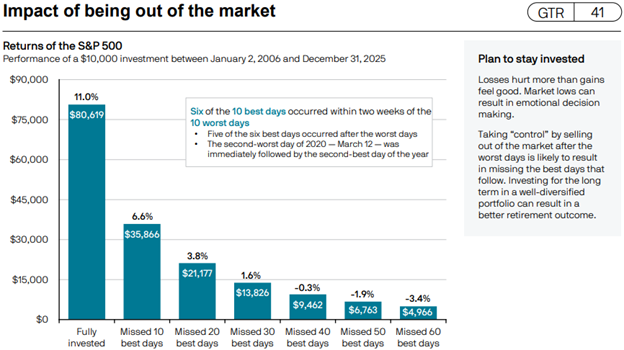
Periods of volatility can feel uncomfortable, but they are a necessary part of investing. Just as the soccer players who remained composed thrived amidst the confusion, successful investing means staying disciplined when emotions run high. While tempting to prevent further loss, selling into volatility often means missing out on recoveries. If feelings of doubt ever start to emerge, reach out to your advisor to make sure your investment portfolio is aligned with your goals and risk tolerance. Your long-term investment success matters to us.