
The AI Market Ride: Thrills, Spills, and Smart Diversification
April 20, 2026
 By Carson Turnis
Wealth Management Intern
Over the last few years, we have witnessed a rapid expansion in the capabilities and adoption of artificial intelligence (AI). Artificial intelligence ranges from reactive machines that perform simple tasks to complex generative apps like ChatGPT. AI is an integral part of our society and is increasingly getting incorporated into our lives each day. In the last five years alone, AI has taken everyone by surprise with its rapid technological progress, making AI an attractive industry to invest in. In times of enthusiasm, it is essential to invest strategically and stay diversified to position yourself for success.
Since early 2023, technology stocks have powered markets higher. Many AI companies have experienced significant valuation growth. NVIDIA, a leading graphics processor unit (GPU) manufacturer, has seen a valuation expansion over 1,000% in the last five years. In 2025, NVIDIA drove roughly 20% of the S&P 500’s return, showcasing the powerful impact of AI on the market. Since AI has driven a large portion of market returns, it is a worthwhile industry to invest in. The great Warren Buffett once said, “Be fearful when others are greedy and greedy only when others are fearful.” In other words, be prepared to invest in a down market and be willing to trim stocks in an overvalued market.
It is important to understand the risk of investing in high-performing markets. Greed, excitement, and fear can turn stocks into a rollercoaster. The first stage of the investing roller coaster is excitement. An influx of positive news, innovation, and media coverage can build momentum for stock prices to surge. Next comes greed. Investors’ perspectives shift from “Is this worth it?” to “How much higher can this go?” Investors get overconfident and purchase more shares to follow the “herd.” During this phase, the fear of missing out (FOMO) also kicks in. New investors begin to pile in as they don’t want to miss out. Greed and FOMO often lead to a stock’s price rising well above what its underlying business fundamentals justify. The next phase is the turning point. After a stock’s price has escalated, earnings might not match expectations, news may slow down, or early investors may sell, leading to a decline in the stock’s valuation. This transitions us into the last stage, panic. Investors see prices dropping and sell in a panic, causing prices to plummet further. Investors late to the party often take the biggest hits. By understanding the concept of behavioral finance, investors can make more well-informed decisions.
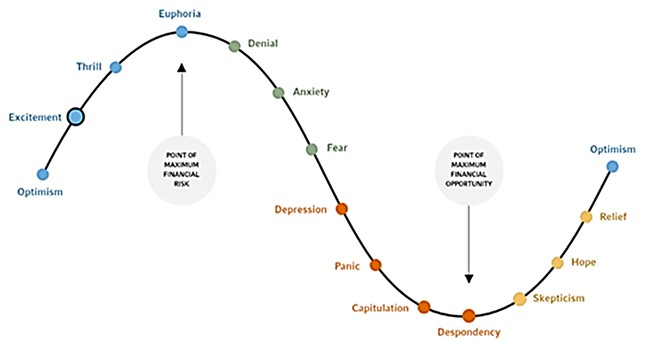
Source: Behavioral Finance and Market Downturns - Retirement Tips
While understanding psychology in investing is important, it is still immensely difficult to read the markets. Diversification is a top strategy to minimize the risks associated with investing. It is the process of spreading your investments across different asset classes and industries to reduce risks. The idea is that if one asset is performing poorly, then you might hold a different asset that is performing well to help balance things out. It is important to never “put all your eggs into one basket.”
In conclusion, AI is a fast-growing industry that should prove to be a worthwhile investment. By being aware of the effects of behavioral finance on the market and maintaining a diversified portfolio, you will enhance your likelihood of financial success. Please reach out today if you’d like to discuss more about AI in your investment plan, or if you have other questions, we are here to help.