
The Fed’s Balancing Act: When Patience Matters
October 26, 2026
 By Tom Limoges, MBA
Vice President - Investments
Have you ever reviewed your household budget and wondered where all the money went? Maybe the utility bill was unusually high, an unexpected car repair showed up, or a family trip pushed expenses above normal. One expensive month does not necessarily mean your everyday spending habits have changed. Before making changes to the family budget, it helps to understand what drove the increase.
The Federal Reserve faces a similar challenge this week. Inflation remains above its 2% target, but the important question is whether higher prices are becoming widespread or are concentrated in a few categories. That distinction could influence whether the Fed raises interest rates again or chooses to wait.
Reading Beyond the Headline
Inflation has cooled considerably from highs earlier in the decade, but progress has been uneven. Recent price pressures have included energy, tariffs, and certain technology-related products and services. These increases matter to households and businesses, even if they do not reflect the same inflation trend across every part of the economy.
To get a clearer picture, economists examine several measures of inflation. One is trimmed mean inflation, which excludes the largest price increases and decreases each month. Think of it as reviewing your regular household expenses separately from the unusually large bills. It does not make those bills disappear, but it can help identify whether the underlying spending pattern has changed.
The Fed’s Next Move
The Fed has two important responsibilities: maintaining price stability and supporting maximum employment. Raising short-term rates can help slow inflation by increasing borrowing costs, but too much tightening can also weigh on consumer spending, business investment, and economic growth. After raising rates in September, policymakers now face a decision about how much additional action is necessary.
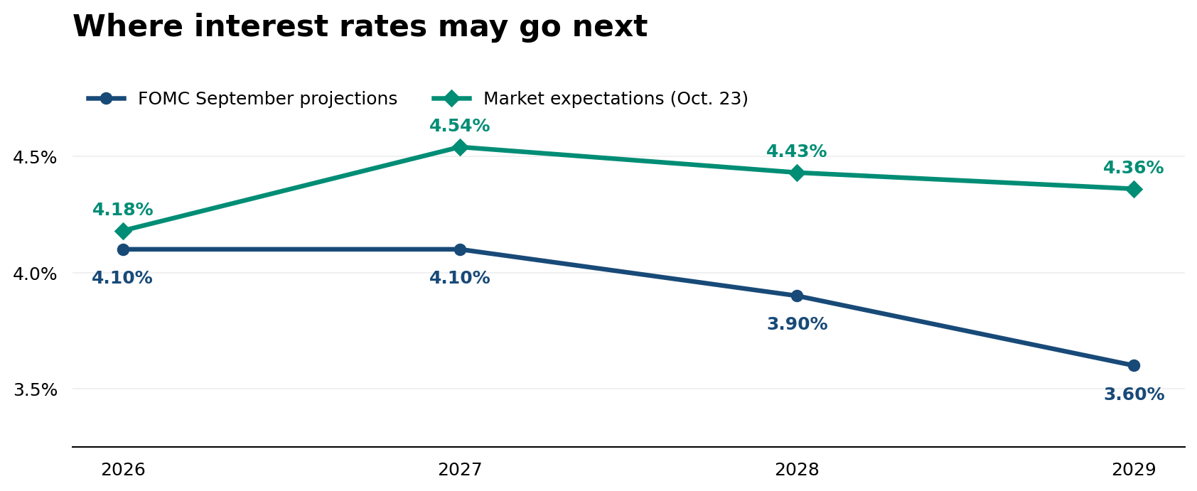
The chart below from J.P. Morgan Asset Management illustrates why the outlook is far from settled. The Fed’s September projections suggest its policy rate could decline gradually in the coming years. Market expectations as of October 23, however, imply that rates may stay higher for longer. By 2029, the market-implied rate is about 4.36%, compared with the Fed’s projection of 3.60%. These are forecasts, not promises, and both will change as new information becomes available.
Source: J.P. Morgan Asset Management; market expectations as of October 23, 2026.
What This Means for Investors
For investors, the direction of interest rates has important implications for both stocks and bonds. Higher interest rates have created challenges for existing fixed-income investments as bond prices generally move in the opposite direction of yields. However, today's higher yields also provide more attractive income opportunities than investors experienced for much of the past decade.
Equity markets are similarly sensitive to interest-rate expectations. Higher borrowing costs can pressure corporate profits and valuations, particularly for companies that depend heavily on financing future growth. However, a stable interest-rate environment, combined with continued economic growth and healthy corporate earnings, could provide a favorable backdrop for equities.
The challenge for investors is that predicting the future direction of interest rates is difficult. As the accompanying chart illustrates, even the Federal Reserve and financial markets have different expectations about where rates are headed over the next several years. Rather than positioning portfolios around a single interest-rate forecast, maintaining a diversified approach across stocks and bonds can help investors navigate a range of potential outcomes.
Staying Focused on the Long Game
This week’s Fed announcement will generate plenty of headlines. However, much like one expensive month should not dictate a family’s entire financial plan, a single interest-rate decision should not determine an investor’s long-term strategy. A disciplined approach built around diversification, quality investments, and individual goals remains more important than predicting the next move in rates. Please reach out to your advisor if you have questions or concerns. Your success matters.