
U.S. National Debt Hits $40 Trillion-Should Investors Be Worried?
August 31, 2026
 By Matthew Andera
Securities Analyst
The U.S. national debt recently crossed the $40 trillion threshold, prompting a flurry of headlines across financial media. While the specific amount is more psychological than ominous, a number this large is difficult for most of us to comprehend. To help put this figure into perspective, 40 trillion is:
• Roughly 13 times the total number of trees on planet Earth (three trillion).
• More cells than in the human body (~35 trillion).
• In dollar bills laid end-to-end, enough to reach the sun and back 20 times.
• Roughly three times the wealth of the world’s 500 richest individuals ($13 trillion).
• Approximately $117,000 of debt per U.S. citizen.
What’s more, there are few signs of this debt snowball slowing down. Why does the national debt continue to rise, and what does it mean for investors?
The Federal Budget
Understanding why the debt continues to climb comes down to the mechanics of the federal budget. Spending falls into three categories: mandatory spending (such as Social Security and Medicare), discretionary spending (including national defense and infrastructure), and net interest paid on existing debt. When tax revenue falls short of these obligations, the government runs a deficit and issues new Treasury bonds to cover the difference. As shown in the chart below, mandatory spending accounts for over 60% of the federal budget, while defense spending represents 12%, other discretionary spending 13%, and interest payments 14%.
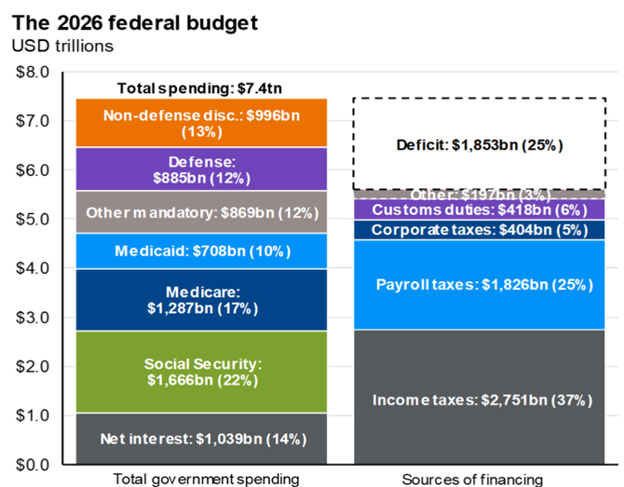
Source: JP Morgan Guide to the Markets, Data as of 8/27/26
Given the large share of the budget devoted to mandatory programs and debt service, there is limited room to reduce spending and narrow the budget deficit without significantly increasing revenue. Additionally, Tom highlighted last week that longer-term interest rates increased this year. As yields rise, the cost of paying interest on existing federal debt increases. As such, it is expected that interest on existing debt will continue to account for a growing portion of the federal budget.
Economic Context
While $40 trillion is an enormous sum, it is important to add some additional context through the lens of the world’s largest economy. To evaluate the nation’s capacity to service its debt, economists often examine debt as a percentage of Gross Domestic Product (GDP), or how we measure economic output. As shown below, U.S. debt at the end of 2025 was about equal to annual GDP.
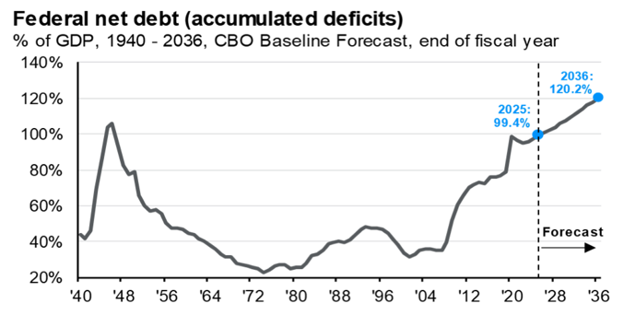
Source: JP Morgan Guide to the Markets, Data as of 8/27/26
The good news? We are not in uncharted territory, with debt to GDP approaching levels seen towards the end of World War II. Though the challenge, however, is that meaningful debt reduction would likely require some combination of higher taxes and lower spending – which historically has not been a popular political platform. As such, we are unlikely to see a slowdown of this trajectory in the near term.
Investor Implications
All told, rising debt levels alone are not a reason for panic. Markets have been aware of this growing debt for years, and the $40 trillion milestone does not tell us what markets will do next. Economic growth, inflation, Federal Reserve policy, and corporate earnings are likely to have a much larger impact on investment returns moving forward. That does not mean the national debt is irrelevant. Over time, rising debt and interest costs could put upward pressure on interest rates, constrain fiscal policy, and create additional challenges for policymakers. But these are longer-term considerations rather than reasons to make dramatic changes to an investment portfolio based on a single milestone.
For investors, it is more important to focus on what is within our control, particularly maintaining a diversified portfolio across asset classes to withstand a range of economic and market environments. While prudent fiscal management may not be at the top of Washington’s priority list, it is a topic that greatly matters to us. To further discuss the national debt or to craft a strategy to tackle personal debt and solidify your household balance sheet, please reach out to your advisor. Your success matters.