
Wall Street's NIL Collective: The Race to Fund AI
July 20, 2026
 By Isaac Conner
Investment Intern
Over the past few years, college athletics has changed dramatically. NIL (Name, Image, and Likeness) compensation and the transfer portal have created a more fluid marketplace for talent. Programs increasingly feel pressure to commit resources toward attracting and retaining players simply to keep pace with their competitors. For many schools, the question is no longer, “Should we spend?” but “Can we afford not to?” Corporate America may be facing a similar dilemma.
The clearest evidence of this can be seen in the investment plans of the world's largest technology companies. Capital spending from Google, Amazon, Microsoft, and Meta has increased substantially in recent years. The graph below illustrates how AI has evolved from an emerging technology initiative into one of the largest capital investment programs in modern corporate history.
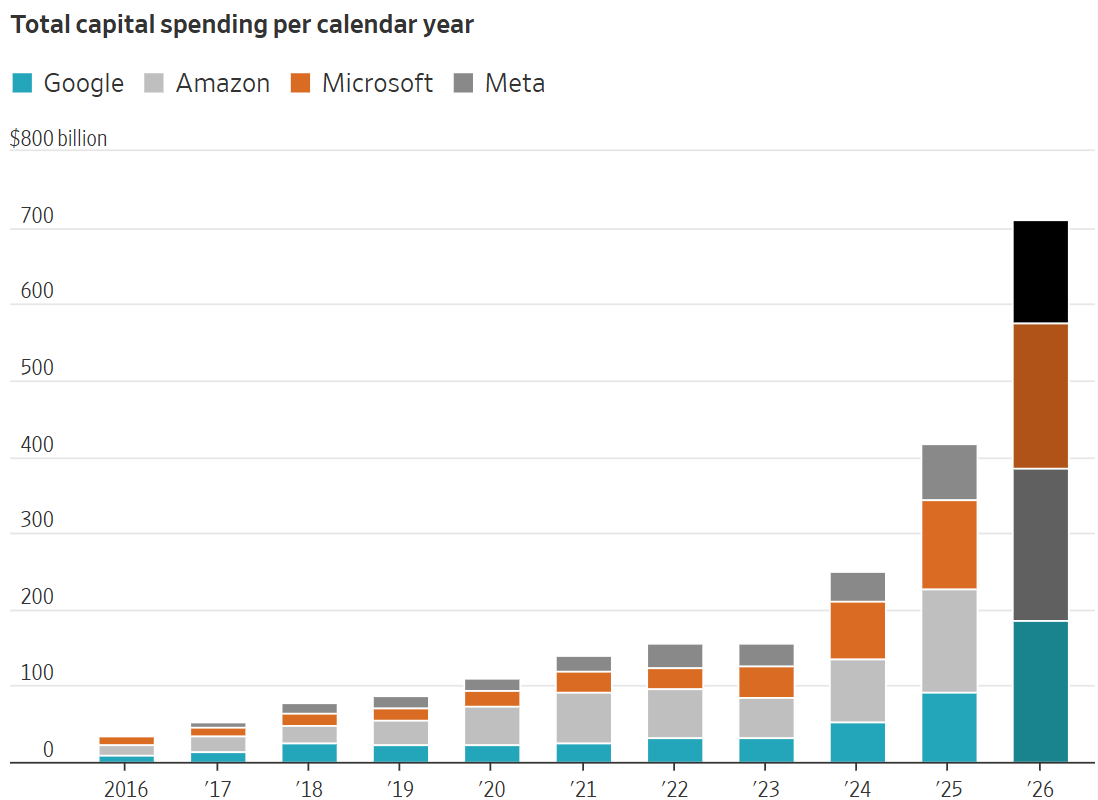 In 2021, combined capital spending for these four companies totaled just over $100 billion. By 2025, that figure had climbed to roughly $400 billion, and spending is projected to approach $700 billion in 2026. Few corporate investment cycles in recent history have expanded at this pace. Much of this spending is being directed toward data centers, computing capacity, and AI infrastructure. Competition appears to be creating powerful incentives for companies to continue investing, even as costs rise. College athletics offers a useful reminder: larger NIL budgets do not automatically produce championships. Likewise, investors are beginning to ask whether larger AI budgets will automatically produce better business results.
The Cost of Staying Competitive
Just as NIL programs rely on donors, large scale cloud service providers (hyperscalers) increasingly rely on investors to fund AI expansion. Earlier in the decade, hyperscaler bond issuance remained below $50 billion. In 2025, it reached approximately $100 billion. This year, issuance is approaching $240 billion. Investors have largely been willing to provide capital as companies race to secure computing power and AI infrastructure.
This competition is not funded solely through operating cash flow. Wall Street helps finance data centers, AI infrastructure, and AI supply chains. In many ways, Wall Street has become the NIL collective for the AI buildout.
The competition is also expanding beyond the largest technology companies. SK Hynix, one of the world’s leading suppliers of memory chips used in AI computing, recently completed a $26.5 billion U.S. listing, the largest listing ever by a foreign company. The broader takeaway is that companies throughout the AI ecosystem are increasingly seeking capital to expand capacity and remain competitive. Investor enthusiasm for unlimited AI spending may be beginning to cool as evidenced by weakening bonds after issuance by Nvidia and SpaceX. Amazon recently raised $25 billion through a bond offering just months after issuing another $37 billion of debt, because investors demanded more attractive borrowing terms. College teams spending NIL dollars does not guarantee championships. Similarly, investors are increasingly asking a simple question: Does spending create value, or merely keep companies in the race?
The Investing Takeaway
History suggests this dynamic is not unique. Railroads transformed transportation and attracted enormous amounts of capital because the economic opportunity was obvious. The technology changed the world, but not every railroad company succeeded. Today's AI buildout may ultimately prove as transformative as railroads, the internet, or electrification. Identifying a transformative technology is often the easy part. Determining which companies will ultimately create lasting shareholder value is much harder.
The transfer portal asks which schools can attract the most talent. NIL asks which programs are willing to commit the most resources. The AI race asks which companies can afford to invest the most to remain competitive. For investors, however, the more important question is which companies will ultimately generate long term shareholder returns.
The lesson for investors isn’t whether AI succeeds, but which companies will ultimately create lasting value from it. History shows that transformative technologies produce both winners and losers. Because predicting those winners is rarely easy, diversification remains a powerful tool for participating in long-term innovation. If you would like to discuss how these themes may affect your portfolio or have questions about your investment strategy, please
reach out to your advisor if you have any questions. Your long-term financial success matters.