
A New Season for Bonds
August 24, 2026
 By Tom Limoges
Vice President - Investments
Football season is almost here. In the coming weeks, teams will take the field with fresh records and anticipation of a deep post season run. Last year's wins and losses shape expectations, but they don't count toward this year's standings. Everyone starts at 0-0. There is a similar idea worth considering in today's bond market.
Rise in Rates Improve Future Outlook
So far, 2026 has been a frustrating year for fixed-income investors. Broad investment-grade bond returns have been roughly flat as longer-term interest rates moved higher. The 10-year Treasury yield rose to approximately 4.7%, while the 30-year Treasury has moved above 5%. As rates rise, existing bond prices fall, which has offset much of the income investors have earned this year. But just as last season's record doesn't determine what happens this fall, year-to-date bond returns tell us very little about the returns investors can earn from this point forward. In fact, the rise in rates hurting bond prices this year has also improved the outlook for future returns.
This chart illustrates the historical relationship between a bond's starting yield (horizontal axis) and its subsequent five-year return (vertical axis). For historical comparison purposes, each decade is color coded. As of August 20, the Bloomberg U.S. Aggregate Bond Index had a yield to worst of 4.93%. Historically, starting yield has been a useful indicator of longer-term bond returns. Based on the relationship shown in the chart, today's yield would imply an annualized return of approximately 5% over the next five years.
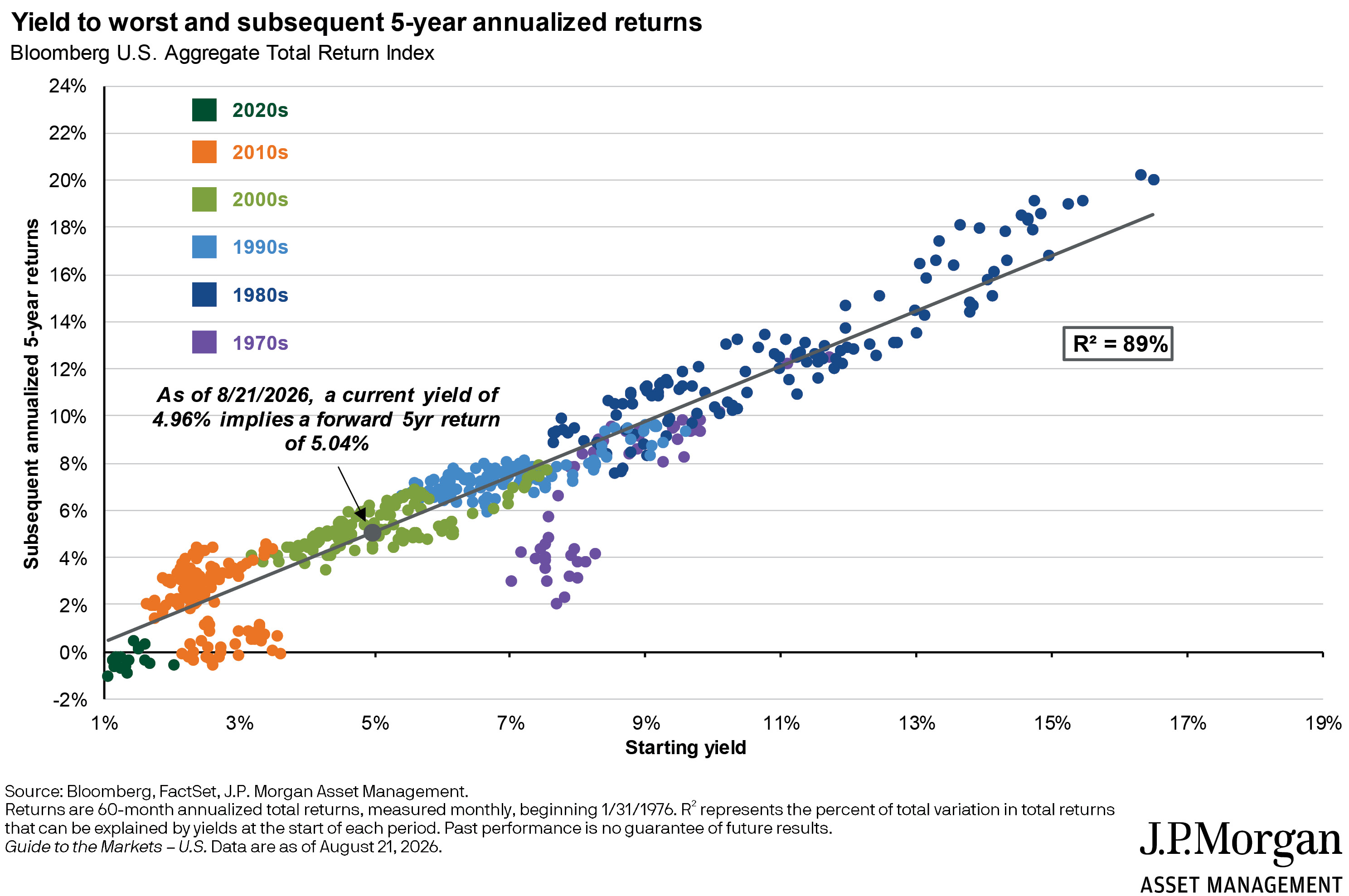
Chart references: J.P. Morgan Asset Management, Guide to the Markets - U.S., data as of August 20, 2026.
The Search for Meaningful Bond Income
That doesn't mean investors should expect exactly 5%. As interest rates move, credit conditions change, and bond prices fluctuate. But starting with nearly a 5% yield gives investors something they simply didn't have for much of the last decade: meaningful income. The opportunities also extend beyond the Aggregate. Investment-grade corporate bonds are yielding around 5.5%, mortgage-backed securities around 5.2%, and several other high-quality fixed-income sectors are offering yields well above their 15-year medians as indicated by the chart below.
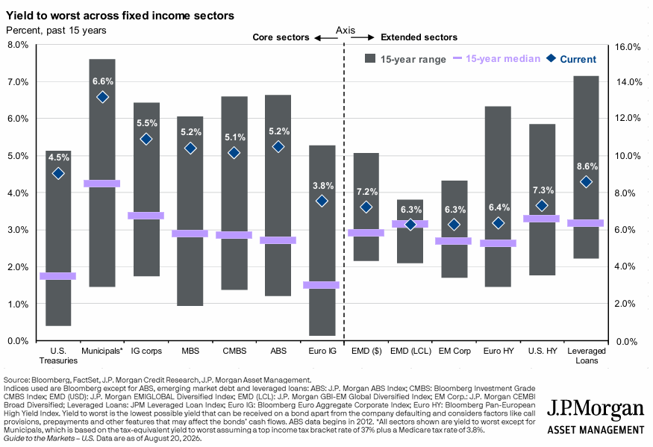
Chart references: J.P. Morgan Asset Management, Guide to the Markets - U.S., data as of August 20, 2026.
That higher income matters for two reasons. First, investors are being paid more, simply to own bonds. Second, the additional income provides a larger cushion against future changes in interest rates. There are still reasons for some caution. Inflation remains above the Federal Reserve's target, federal borrowing remains elevated, and investors have demanded additional compensation to own longer-term Treasury securities. Those issues have contributed to the rise in long-term rates this year and could continue to create volatility. But higher rates aren't necessarily bad news for a long-term bond investor. Eventually, higher rates mean higher expected returns.
Therefore, as football teams prepare to start another season at 0-0, bond investors might benefit from doing something similar. Bond investors don't get to erase what happened earlier this year, but forward returns start from today's yields, not January's yields. From today's starting point, we are more constructive on fixed income than year-to-date returns might suggest. At roughly 5% starting yields, income can once again be a meaningful contributor to total return. We do not need interest rates to fall for bonds to be attractive. If rates eventually decline, price appreciation becomes an additional potential benefit rather than something the investment depends upon. Please, reach out to your advisor. if you'd like to discuss your bond strategy. Your success matters.