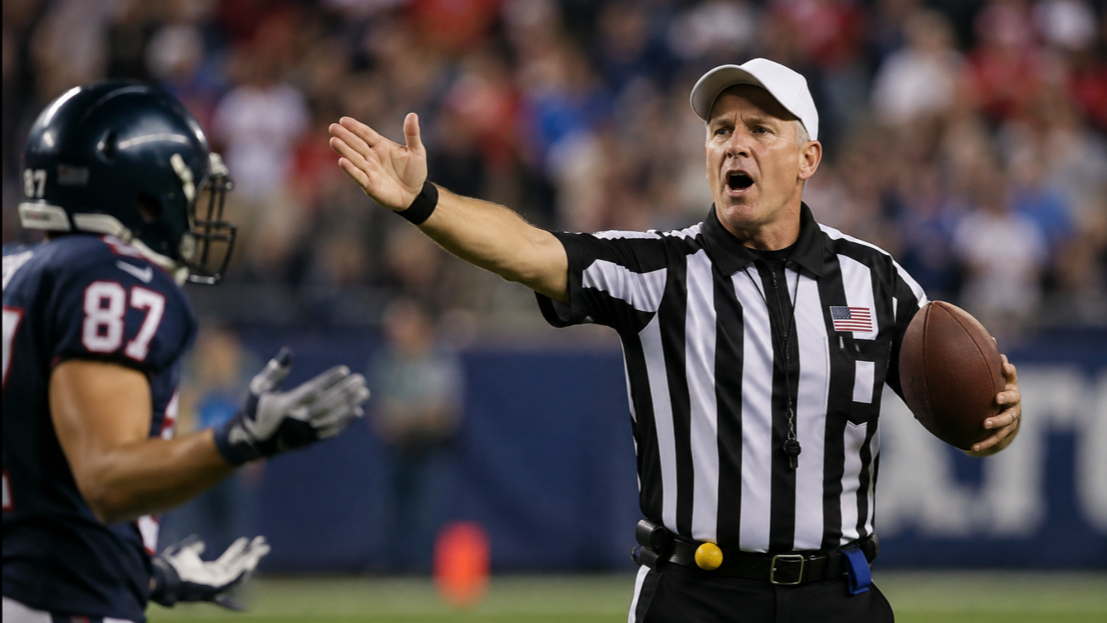
‘Keep your eye on the ball, not the referee…’
August 3, 2026
 By Michael Moreland
Retired VP - Investments
The quote above comes from Kevin Warsh, the new Chair of the Federal Reserve Board, at his July 29 press conference. It was in response to a reporter’s question concerning the Open Market Committee’s decision to drop publication of guidance on its possible future rate actions. How will markets adjust to the absence of this information? Chair Warsh’s answer was straightforward. Market participants will gather information directly from data, just as the Fed does, without the benefit (or crutch) of periodic forecasts from Fed officials. Prices, employment, external shocks, and other relevant information will all factor in future Fed decisions. Markets will evaluate the same data, and willing buyers and sellers will set proper levels for asset prices.
Is this a positive step? Yes. While it’s rare to see less information produce better outcomes, the last several years of forward guidance have been generally wide of the mark as to the actual path of Fed policy rates. Dependence on what the Fed expects has led to a near sense of complacency, leaving most interest rates below where they might be in the absence of the Fed’s internal predictions on inflation, employment, and economic growth.
How Are the Markets Adjusting?
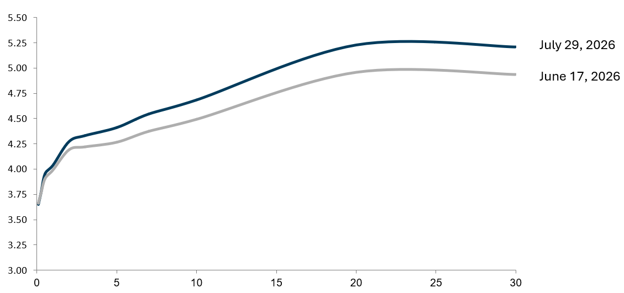
Are the markets adjusting to the absence of forward guidance? Most certainly. The chart below shows the shift of the U.S. Treasury yield curve from mid-June (the last meeting) through last week’s meeting:
Source: Bloomberg
While the change does not appear dramatic, it is significant. Rates – especially longer-term rates – historically have not shown large moves in the absence of Fed action or inflation shocks.
Why did it happen this time? Bottom line, the risk/reward function shifted. The absence of forward guidance, on the surface, creates a higher degree of uncertainty in the decision-making process. Greater uncertainty demands a higher reward for participation. Logic suggests that uncertainty grows as the lock-in period lengthens. That is why longer-term maturities – in normal times – carry higher yields than shorter-dated debt.
The Weight of the Federal Deficit
And, not mentioned by anyone at the Fed, but looming nonetheless, is the failure of Congress and the Administration to show meaningful steps to curtail the growth of the Federal deficit. Higher rewards will be required to absorb the rising issuance of government debt. This is undoubtedly partially responsible for higher rates and the steeper yield curve we see today – markets are reaching the ‘show me’ stage.
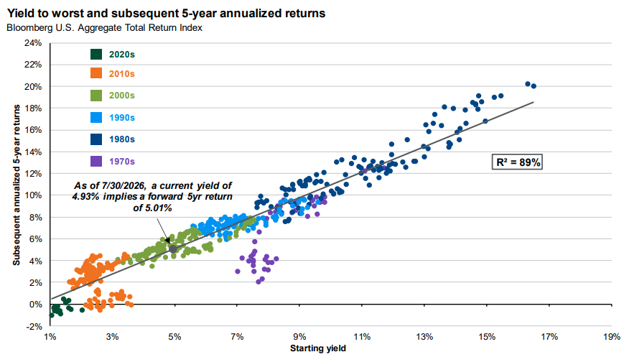
Where does this leave us in structuring bond portfolios for our clients? Actually, in a pretty good place. As Krista Biernbaum pointed out in the Investment team’s quarterly outlook, real (inflation-adjusted) interest rates are at their highest level in years. History also shows that the starting point of rolling five-year periods is a strong indicator of the probable total return realized over a bond’s maturity.
Source: J.P. Morgan Guide to the Markets® as of July 30, 2026
Positive real returns, consistency, and safety of principal in a short- to intermediate-term bond ladder are an invaluable part of broadly diversified balanced portfolio. To see how bonds can help stabilize returns in uncertain times, schedule time to talk to your Investment Manager your advisor to see how our strategies help insure you reach your goals in a timely fashion with controlled risk. Your success matters to us.