Largest IPO Ever: Is SpaceX All Hype or a Home Run?
June 15, 2026
 By Eric Johnson
Securities Analyst
SpaceX made history on Friday by completing the largest Initial Public Offering (IPO) ever. The stock now trades on the Nasdaq exchange under the ticker SPCX. Led by Elon Musk, SpaceX spans multiple high-growth areas, including reusable rockets, satellite-based internet (Starlink), and artificial intelligence following its merger with xAI. The debut generated unprecedented buzz in the investment world. Some view the company as a transformative opportunity, while others worry the hype and valuation introduces volatility into broader markets. Let’s dive into some of the details.
SpaceX: By the Numbers
According to its S-1 filing, SpaceX generated $18.7 billion in revenue in 2025, while reporting a net loss of $4.9 billion (see below). Starlink remains the company’s primary revenue driver, accounting for about 61% of total sales, with the remainder split between launch services and artificial intelligence. At its IPO valuation of roughly $1.77 trillion, SpaceX trades around 95x sales, a stark contrast to the S&P 500’s price-to-sales ratio of roughly 3-4x. This highlights how much future growth investors are pricing into the stock.
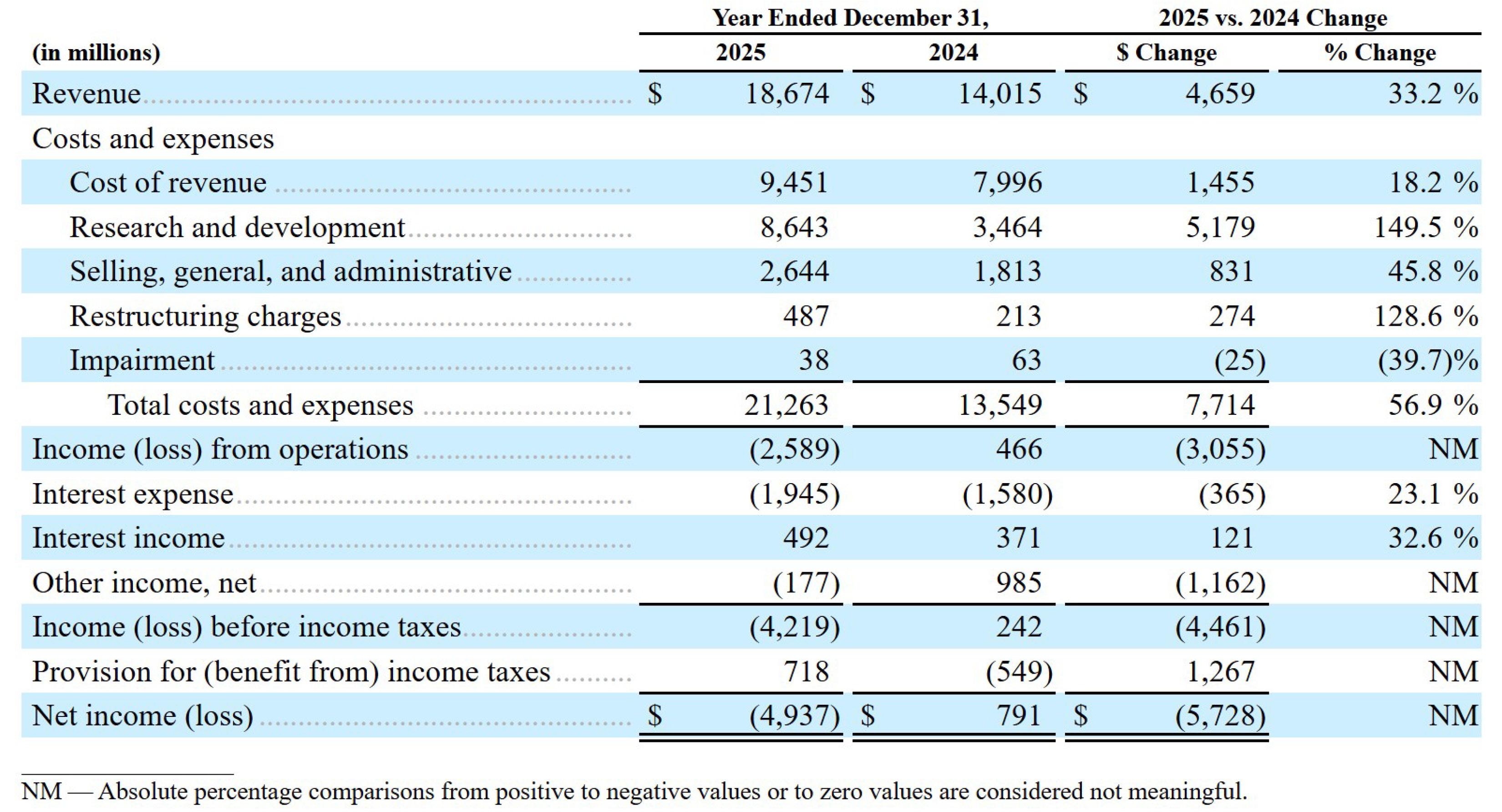
Source: Space Exploration Technologies Corp. Form S-1
SpaceX’s losses accelerated in the first quarter of 2026, with the company reporting a $4.3 billion net loss, nearly matching its total losses for all of 2025. The widening deficit was largely driven by a sharp increase in capital expenditures. SpaceX spent $10.1 billion on capex in the first three months of the year alone, roughly doubling its prior pace (see below). Notably, more than 75% of that spending was directed toward its artificial intelligence operations, reflecting a broader trend among U.S. mega-cap technology companies investing heavily in AI infrastructure.
 Source: Space Exploration Technologies Corp. Form S-1
For SpaceX, Inclusion Rules are Key
A key question following the IPO is how quickly SpaceX will be added to major indexes. Typically, newly public companies must go through a “seasoning period” of several months before being included to allow for price discovery and liquidity. However, given SpaceX’s size, Nasdaq introduced a “fast entry” rule, allowing it into indexes like the Nasdaq-100 after just 15 trading days. Supporters argue this ensures indexes accurately reflect the largest companies. Critics counter that such a short timeline may increase volatility for index funds and passive investors.
By contrast, S&P Dow Jones Indices (owner of the S&P 500) has not changed its inclusion rules. To qualify for the S&P 500, companies must be profitable over the most recent quarter and trailing four quarters. Since SpaceX is currently operating at a loss, it does not yet meet these criteria. The S&P 500 uses a float-adjusted market capitalization methodology, meaning only publicly traded shares are considered in a company’s index weight.
Currently, just 4% of SpaceX’s shares are publicly available, with the remainder held by insiders and employees. In addition, the S&P 500 requires a minimum public float of 10%. Therefore, SpaceX will need to increase the number of tradable shares, likely as lock-up periods expire and insiders begin to sell. Even at that threshold, SpaceX’s index weight would be modest, at roughly 0.5%, making it around the 40th largest constituent in the index.
More Mega-Cap IPOs on the Horizon
SpaceX likely won’t be the last mega-cap IPO we see in 2026. OpenAI and Anthropic have both reportedly filed to go public later this year, with valuations approaching $1 trillion. While it’s easy to get caught up in the excitement surrounding high-profile IPOs, it’s important to step back and stay grounded in your investment philosophy. No one can reliably predict short-term stock movements, including us.
What investors can control is maintaining a well-diversified portfolio focused on value and high-quality investments, an approach that has historically led to better long-term outcomes than chasing the latest market trend. If you have questions about SpaceX, IPOs, or your portfolio, please reach out to your advisor. Your financial success matters.