
Private Credit’s Stress Test: When Investors Want Their Money
March 16, 2026
 By Dustin Saia
Securities Analyst
Investors in some private credit funds are asking for their money back, and in many cases, their withdrawal requests are being denied or limited. Several large funds recently restricted or capped withdrawals after redemption requests rose above the limits allowed under their fund structures. These developments are drawing increased attention to some of the biggest players in the private credit market, including Apollo Global Management, KKR, Blackstone, Ares Management, and Blue Owl Capital. After a decade of rapid growth and strong investor demand, the sector is now facing a major test.
Private Credit Growth
In simple terms, private credit refers to loans provided by non-bank lenders, typically large asset managers, to companies that may not have easy access to traditional bank financing or the public bond market. Over the past twenty years, the market has grown into a multi trillion-dollar industry, offering investors higher yields than traditional fixed income along with the potential benefits of portfolio diversification. The chart below illustrates the industry’s rapid growth while highlighting the variety of investments forms within the sector.
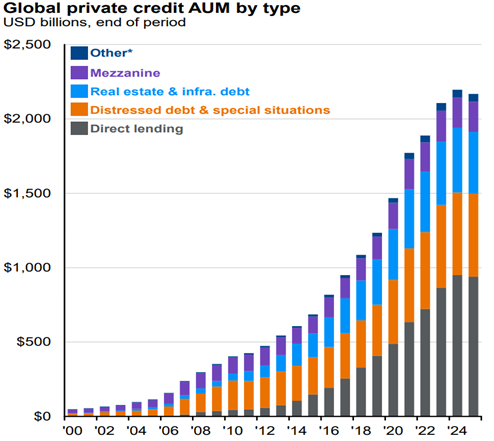
Source: JP Morgan Guide to Alternatives, data as of 1/31/2026
Examining the Tradeoffs
The benefits of private credit also come with important tradeoffs. We discussed some of these tradeoffs previously when examining the implications of private assets in retirement accounts.
From a risk perspective, private credit loans lack transparent daily pricing, making it difficult for investors to quickly detect deteriorating credit conditions. Recent high profile credit events underscore these risks, including the collapse of subprime auto lender Tricolor Holdings and the bankruptcy of U.S. car parts manufacturer First Brands, both of which involved financing tied to private credit lenders.
At the same time, certain sectors heavily financed by private credit are beginning to feel pressure. Private software companies are seeing valuation declines as growth expectations are reset and competition driven by advances in artificial intelligence reshape parts of the industry.
Because the underlying loans of private credit funds are privately negotiated and not traded on public markets, they are significantly less liquid than traditional bonds. When there is concern from investors about the underlying health of the bonds, they may attempt to request their money back from the funds to mitigate losses. The catch is many private credit funds that are available to individual investors offer periodic redemption windows and are typically structured with limits on how much capital can be withdrawn at any given time. If redemption requests exceed those limits, managers can cap or delay withdrawals.
The Fallout and Moving Forward
In recent months, several funds reached their withdraw limits and either limited or denied redemption requests. This forced some investors to wait longer than expected to access their capital and highlighted the liquidity risks associated with these investments.
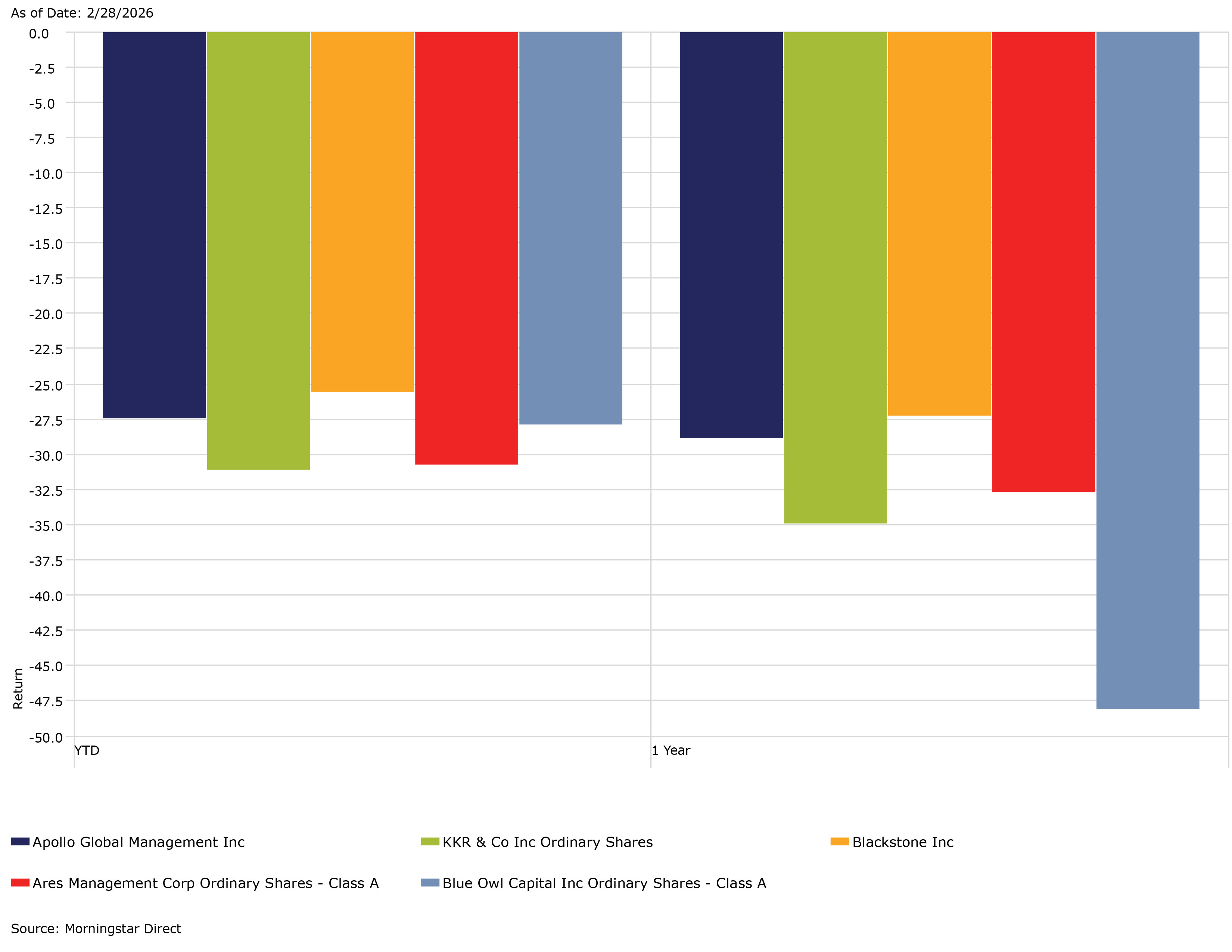
As investors reassess the health of the private credit industry, the largest providers of these assets including Apollo Global Management, KKR, Blackstone, Ares Management, and Blue Owl Capital are also under pressure. The chart below from Morningstar shows year-to-date and one-year performance for these companies, all of which have declined sharply.
 While these developments do not necessarily signal a broader crisis in private credit, they do highlight some of the structural realities of the asset class. We continue to monitor the growth of the private asset space and remain cautious in how these investments are used within portfolios. Not every investment is right for every investor, and our goal is to match opportunities with each client’s liquidity needs and risk preferences.