
The Return of the Bond Vigilantes?
June 1, 2026
 By Mike Moreland
Retired VP - Investments
With all that’s taking place in the world, an underappreciated event is the action of the global bond markets. As of this writing, the benchmark ten-year U.S. Treasury Note is about 4.5%, and the companion thirty-year U.S. Treasury Bond is above 5.0%. Both are multi-year highs.
With the Federal Reserve on hold for now, and with the Fed’s own projections showing lower short-term interest rates over the intermediate term, logic dictates that longer-dated maturities should follow this path. That’s not occurring. It appears to me (among others) that bond market participants are beginning to focus on the unsustainable spending and deficit paths we are on. In response, buyers are backing away from longer-dated debt, and in doing so hoping to force attention to solving this situation rather than continuing to ‘kick the can down the road’.
There’s a history of this behavior. Most prominently, in the early 1990s, President Clinton proposed (for then) massive spending plans without a comprehensive plan to pay for them. Bond markets reacted by going on a ‘buyers’ strike’. Interest rates rose, and the Administration was forced to scale back its spending plans. The period was called ‘The Great Bond Massacre’. The term Bond Vigilantes was coined.
James Carville, the President’s Chief of Staff, was famously quoted: ‘I used to think that if there was reincarnation, I wanted to come back as President or Pope or as a .400 baseball hitter. But now I want to come back as the bond market. You can intimidate everybody’.
Are the bond vigilantes rising again? Perhaps. Our fiscal situation is challenging with no sign of change. A few graphics, courtesy of J.P. Morgan & Co.:
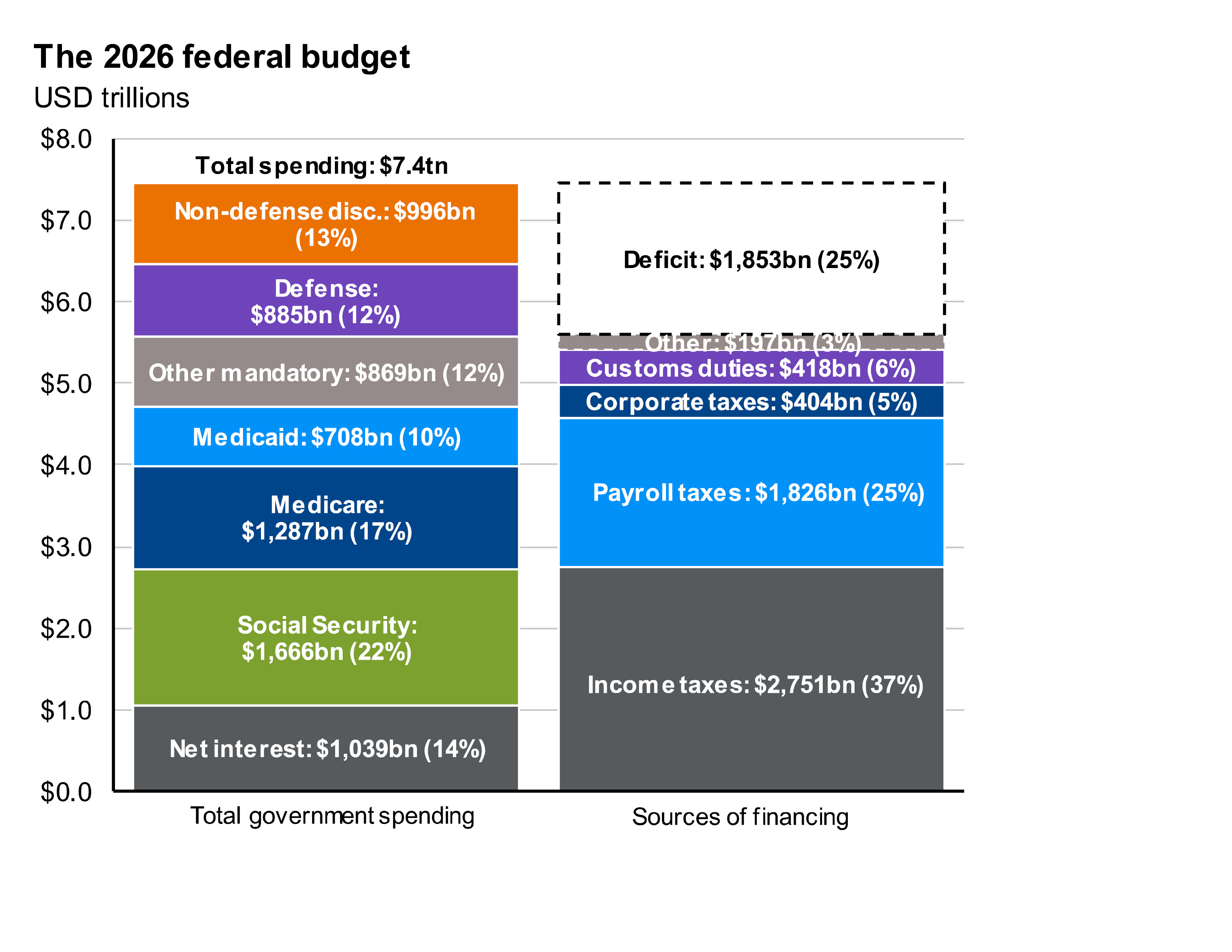
Source: JP Morgan Asset Management, data as of 5/27/2026
A few things stand out. The fiscal deficit is approaching $2.0 trillion and represents fully one-quarter of total spending. This deficit is financed through additional bond sales. The interest payments on currently outstanding debt now exceed $1.0 trillion per year and exceed expenditures on all government programs except Social Security and Medicare. And, the non-partisan Congressional Budget Office does not see an end to this pattern.
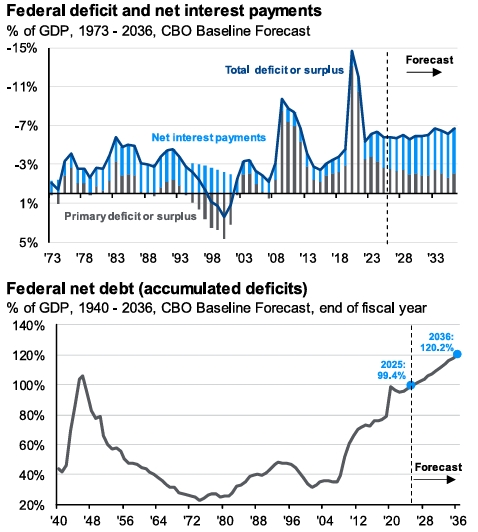
The CBO’s baseline forecast shows interest expense on outstanding debt absorbing a rising percentage of federal outlays over time. Further, without greater fiscal discipline, U.S. net debt outstanding is expected to reach 120% of our GDP in the next decade. This isn’t a banana republic level of fiscal irresponsibility, but it will create the highest debt burden in our history – exceeding that accrued during World War II.
There are only four ways out of this debt trap, and three are not ideal. Higher tax rates, lower spending, or a deliberate decision to ‘inflate away’ the real cost of principal and interest payments over time are not desirable. On the positive side, strong economic growth will generate a higher tax stream, but that will have to be accompanied by below-trend spending. The bond markets are beginning to question whether this will occur and are demanding higher long-term rewards to absorb the rising risks.
The Federal Reserve is perceived as controlling U.S. interest rates, but its day-to-day purview is generally limited to short-term rates. And, its regulatory mandate is to use monetary policy to control inflation and encourage full employment. Historically, the Fed has assiduously avoided injecting itself into political and budgetary considerations. Perhaps, under new Chair Kevin Warsh, the Fed will use its ‘bully pulpit’, to build awareness of the unsustainable fiscal path we are on. Let’s hope so.
Does all this mean an individual investor should ignore bonds? Absolutely not. In last week’s commentary, Sam Richter discussed the value present in short- to intermediate term debt. With the short end of the yield curve offering positive real returns for conservative investors, a healthy exposure in high quality debt is appropriate. Don’t ignore today’s values in fear of what may occur tomorrow.
As always, our task is to ensure your financial safety and success in an ever-changing environment. Talk to your Investment Manager or Advisor to chart the right path for you. If you have any questions, please reach out to your advisor today. Your Financial success matters.